 Back and Next - Back and Next
LESOTHO: Holiday gifts pave the way to self-sufficiency
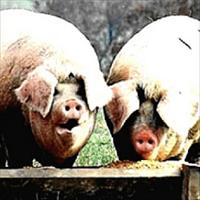
When Mamanuel Rampai heard she would receive a free pig for Christmas a few years ago, purchased by an anonymous donor in the US through an aid group's online gift catalogue, she all but dismissed the present.
But the gift, a seven-month-old sow named Pinki, has since made her a role model for other pig farmers in her rural community. "I've learned so much about how to care for them, because they've become a livelihood," Rampai, 43, told IRIN.
Rampai lives in Turupu, one of Lesotho’s many remote mountainous villages and used to survive on the occasional sale of a chicken and during periods of drought was dependent on international food aid. Her life mirrored the economic stagnancy of the other 80 families in her village, hard hit by the combined effects of poverty, food insecurity and HIV/AIDS.
"Life was difficult for my family," she said in front of the cinder-block home she shares with her seven children. "School fees cost 1,300 Maloti (US$194) per child per year. I couldn't pay for all of them to go to school every year."
Rampai's fortunes changed when the international charity World Vision gave her Pinki. In the last 16 months, Pinki's proven to be an income-generating resource, producing 24 piglets, which Rampai has sold at various points of development to earn between 150 Maloti (US$21) and 1,000 Maloti (US$145) each.
"I never expected I could earn this much by raising pigs," Rampai said in front of Pinki's sty.
Charitable gift catalogues are most popular during the December holiday season, and they've become an integral fund-raising resource for humanitarian aid groups, particularly in the developed world. Most use these catalogues to raise additional funds beyond their traditional donor base, which they then earmark for specific income-generating projects. The idea is that these small grants of animals or other resources – such as fishing kits or beehives – can offer people tools to emerge from lives of poverty and dependency.
Funds for Pinki were donated through World Vision's gift catalogue – which allows charitable shoppers to 'buy' symbolic presents for impoverished communities. An individual donor can choose dairy goats in Malawi, alpacas in Ecuador, and in this case – pigs in Lesotho. A charitable online shopper in the US clicked their mouse and paid $195 to cover the cost of the pig, which World Vision then granted to Rampai.
In the US alone, a number of charities and humanitarian aid groups use gift catalogues, including Heifer International, United States Fund for the UN Children's Fund, Oxfam America, and Samaritan's Purse. In recent years, similar catalogues have also become a fund-raising tactic for evangelical churches engaged in global service work, such as Cooperative Baptist Fellowship and Lutheran World Relief.
These catalogues are gaining in popularity, as consumers in the developed world look for alternative, quirky, and original gift ideas. World Vision says donations to its gift catalogue have climbed by 160 percent in the last three years. This year, it expects to raise US$23 million through the gift catalogues alone.
Changing lives
Donations to these gift catalogues are usually symbolic. For example, Oxfam America says on its website that money raised through its gift catalogue supports the organisation's many programs; it doesn't guarantee that money donated for, say, a camel, will actually be used only to buy a camel. Yet most humanitarian groups using gift catalogues say they do their best to funnel the money in accordance with the donor's preferences.
The grants though are not symbolic for beneficiaries such as Rampai. Next year, she expects to have the funds for her 20-year-old daughter to complete high schooling and hopes that her daughter will continue her education at a university in neighbouring South Africa the following year.
She's also sees hope for her own future. "I want to have a highly improved life when I am an old lady, so my life gets easier in old age," said Rampai.
Nine other families in her village were given pigs at about the same time. So far, they've given or sold a number of piglets to needy neighbours, and sold older offspring to the slaughterhouse in the capital, Maseru. In little more than a year, the group has raised 10,000 Maloti (US$1,445). A portion of this is used to support the village's five children orphaned by HIV/AIDS with school uniforms and materials – a condition all recipients agreed to when they received the pigs. The rest of the earnings are divided between them.
Village chief Mathato Leluma told IRIN these were the area's first entrepreneurs. "The way they are regularly feeding the pigs, and even fetching water from far away during the drought. It shows they're determined to make it a success."
However, the grant project has created tensions within the village. "When we see that people are jealous, we encourage them to form the same kind of group," said villager Molulela Ramanyaka, 29. "And we ask them to buy our pigs."
Other members are dreaming big; they see Turupu becoming a key pig farming community in the coming years.
"Right now, we have to go all the way to Maseru to reach a slaughterhouse. That's two hours away," said 38-year-old Makhabela Macheli. "My wish is that in 10 years we'll build our own slaughterhouse to serve this area. And, yes, I want to be the boss."
Sustainable growth
World Vision Lesotho says of all its operations, the small capital investments supported by the gift catalogue are the most life-changing, because they are run by individual families.
"This project is strong on sustainability because it targets the household," said Hape Matli, operations director of World Vision Lesotho. "Everyone takes care of their own projects, compared to when we pool people together."
World Vision still supplies feed for the pigs. Matli says she would like to design a model in the future where beneficiaries take full financial ownership of the project more quickly, which may entail more training in business skills. Matli said group members often do not know the fair market value of their livestock, so they may not earn as much as they deserve.
In the last year, more than 80,000 individuals have made donations through World Vision's gift catalogue.
US donors Kyle and Kim Geiger, of Washington State's Redmond, have developed an annual tradition around the gift catalogue. On Christmas morning, their six children open their own gifts, and then the family gathers around the home computer. Each child chooses one gift for someone else in need.
"But the gift catalogue is a way to involve our children in the importance of seeing that we do have this responsibility to take care of the poor," he said in a telephone interview with IRIN. "It's a small thing really, but it introduces them to the idea of sharing."
Sharing that makes a difference to recipients like Rampai.
"If I could talk to the donor in America who made this possible, one thing I'd say is that I'm very thankful for the help they've given us. Because this has improved our lives," Rampai told IRIN.
 See Also - See Also